
“You must gain control over your money, or the lack of it will forever control you.” — Dave Ramsey.
Learning about personal finance and mastering money 💰 has been a goal of mine ever since I hit the age of thirty. One of the books that I read recently was the Little Book of Common Sense Investing by John C. Bogle 📖. Overall, it was a good read, though I found it somewhat repetitive towards the end. Personally, I enjoyed Dave Ramsey’s book, The Total Money Make Over and Ramit Sethi’s book, I will Teach you to be Rich more, however, this book still has it merits. I will rate it 3 /5 ☺️.
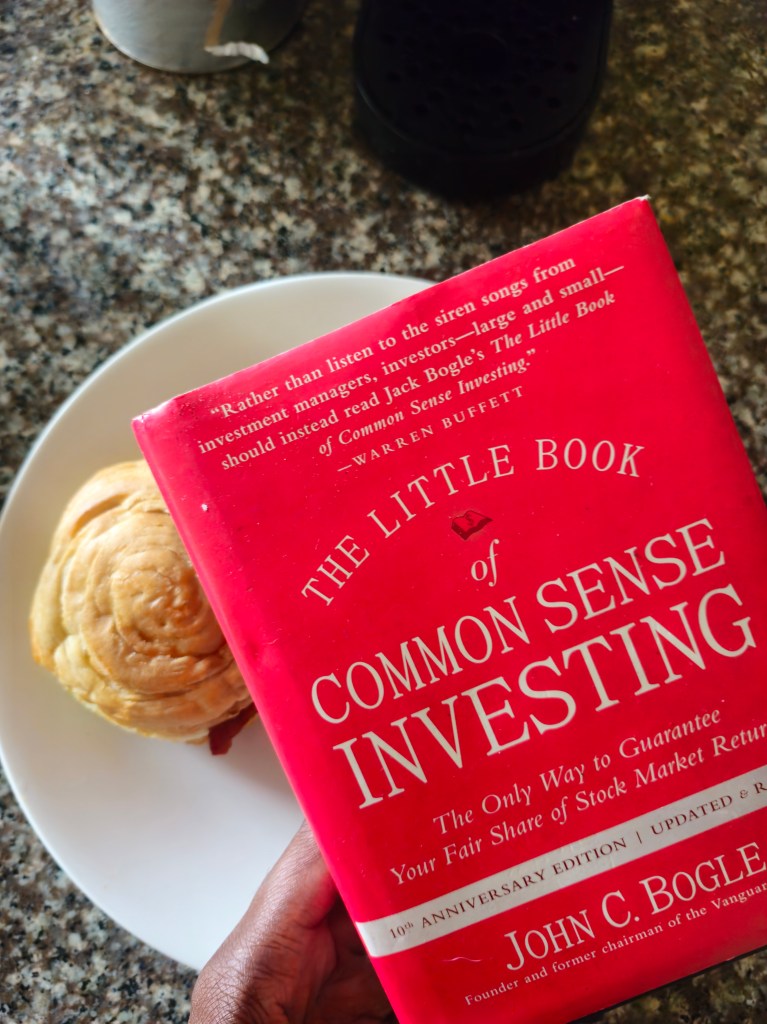
Mr. Bogle made a strong case for why traditional index funds are the best option for investors, arguing that attempting to beat the market with individual stocks 💲or mutual funds is a losing strategy. Instead, he advocates for low-cost index funds with minimal fees to maximize returns 💰. He stresses that investing should be approached as a long-term game, focusing on buying and holding over time. From my limited research, I fully agree with this approach, buying stocks is about buying and holding not trying to sell at each increase in the stock price or selling at every downturn in the market, overall, the market trends upwards and hopefully, this will continue for the next twenty to thirty years. I absolutely disagree with the philosophy of day trading or forex trading 💱🤑 or crypto. If it is for you it is for you, it is not my cup of tea ☕️.
The quote below summarizes the entire book 📚
The best way to implement this strategy is indeed simple: Buy a fund that holds this all-market portfolio, and hold it forever. Such a fund is called an index fund. The index fund is simply a basket (portfolio) that holds many, many eggs (stocks) designed to mimic the overall performance of the U.S. stock market (or any financial market or market sector).
Some of the Key Concepts highlighted in this book include (defintions below are from Chat GPT):
💰Mutual Fund – A mutual fund is a type of investment vehicle that pools money from multiple investors to purchase a diversified portfolio of assets, such as stocks, bonds, money market instruments, or other securities. Mutual funds can be actively managed (where managers make decisions about which securities to buy/sell) or passively managed (like index funds that track a market index). Eg, Roytrin in RBC Bank and Abercrombie Fund and Immortelle Fund in First Citizens Bank, Republic Money Market Fund at Republic Bank or the Scotia Money Market Fund at Scotia Bank.
💲Index fund – An index fund is a type of mutual fund or exchange-traded fund (ETF) that aims to replicate the performance of a specific market index, such as the S&P 500, Dow Jones, or TTSE Composite Index (for Trinidad and Tobago). An index fund is an investment fund that passively tracks the performance of a specific market index by holding the same securities in the same proportions as the index. If you invest in an index fund that tracks the S&P 500, you’re essentially investing in 500 of the largest U.S. companies, in proportion to their market value.
🤑Investing – Investing is the act of allocating money to assets like stocks, bonds, mutual funds, or real estate with the goal of generating long-term growth or income. Investors typically hold these assets for years, focusing on building wealth over time through appreciation, dividends, or interest. It involves patience, strategic planning, and an understanding of the underlying value of what you’re buying.
💱Trading – Trading refers to the buying and selling of financial assets—such as stocks, currencies, or commodities—with the goal of making quick profits from short-term price movements. Traders aim to capitalize on market fluctuations and often hold assets for a much shorter period—ranging from minutes to weeks. Trading requires frequent market monitoring, technical analysis, and a higher tolerance for risk.
💸Bonds – A bond is a fixed-income investment where an investor lends money to a borrower—typically a government or corporation—for a defined period at a fixed or variable interest rate.
💶Stocks – A stock is a type of security that signifies proportionate ownership in a corporation. Holding a stock entitles the investor to a share of the company’s profits and assets, and often gives voting rights in major corporate decisions. If you buy 100 shares of Republic Bank Limited (RBL), you own a small part of that company. If RBL earns profits and declares a dividend, you receive a portion of it. If RBL’s stock price goes up, your investment gains value.
PS. I am no finance expert, neither did I study finance at any level but I am just a person trying to increase my financial literacy by reading books on this topic 📖📚
Much Love
Celly ❤️
 Celly Hikes